

Mubashar Ali is a computational physicist specializing in first-principles simulations and atomistic modelling of functional materials. He works on understanding and predicting the electronic, structural, and thermodynamic properties of materials using density functional theory (DFT) and advanced computational techniques.
His research focuses on low-dimensional materials, van der Waals heterostructures, hydrogen storage materials, MAX phases, and functional perovskites. Through computational modelling, he investigates how atomic-scale structural engineering such as layer-sliding, intercalation, and surface adsorption can tune the physical and chemical properties of materials.
He has authored multiple peer-reviewed publications in international journals and continues to explore new directions in computational materials science, nanoscale energy materials, and machine-learning-assisted materials discovery. His research aims to accelerate the design of next-generation materials for energy storage, catalysis, thermoelectric, and nanoelectronics applications.
Currently, his research is centered on the first-principles modelling and theoretical design of electrocatalysts for the methanol electrooxidation reaction (MOR). His ongoing work involves:
-
Conducting first-principles modelling to design and analyze electrocatalysts for MOR.
-
Investigating MXene-supported metal systems to improve catalytic activity and stability.
-
Employing DFT and complementary computational methods to explore mechanistic pathways and interfacial electronic interactions.
-
Identifying key performance descriptors to establish guiding principles for the rational design of next-generation MOR electrocatalysts.
Scientific Talks & Presentations
- Poster Presentation at Lem Next Gen Science Forum (April 28–29, 2026)
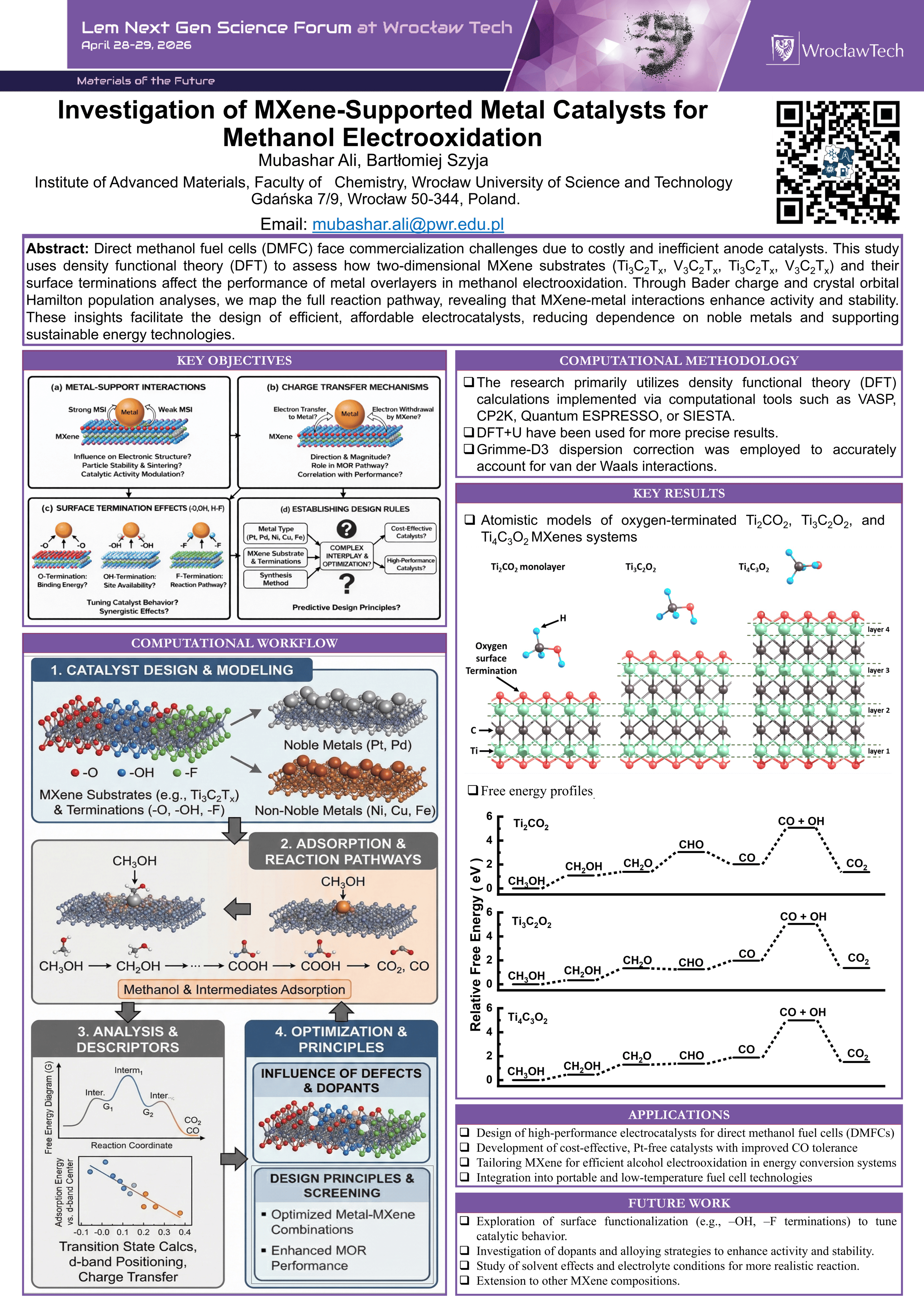
He participated in the Lem Next Gen Science Forum, organized by Wrocław University of Science and Technology, Wrocław, Poland. He presented a poster entitled “Investigation of MXene-Supported Metal Catalysts for Methanol Electrooxidation,” showcasing computational insights into MXene-based electrocatalysts for energy-related applications. 🔗 Conference website 📄 Abstract book (PDF)
- Invited Speaker at ICCRT-2025 Conference (December 20–21, 2025)
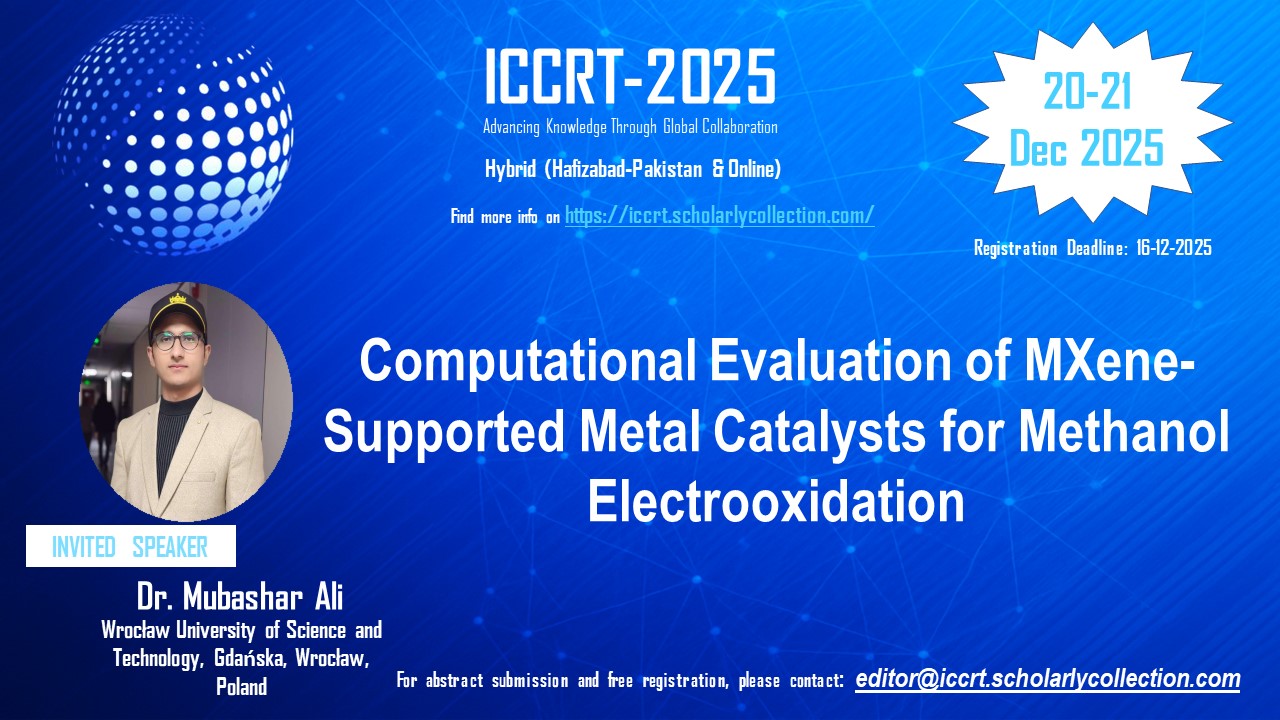
He participated as an Invited Speaker at the International Conference on Current Research Trends (ICCRT-2025), a hybrid international conference held with online participation. He delivered an invited talk entitled “Computational Evaluation of Perovskite-Supported Metal Catalysts for Methanol Electrooxidation,” focusing on computational strategies for the design and evaluation of advanced electrocatalysts for energy applications. 🔗 Conference website 📄 Tentative Schedule (PDF) 🎥 Open ceremony 🎥 Invited talk
- Poster Presentation at Mini-Symposium “Interactions” (November 28–29, 2025)
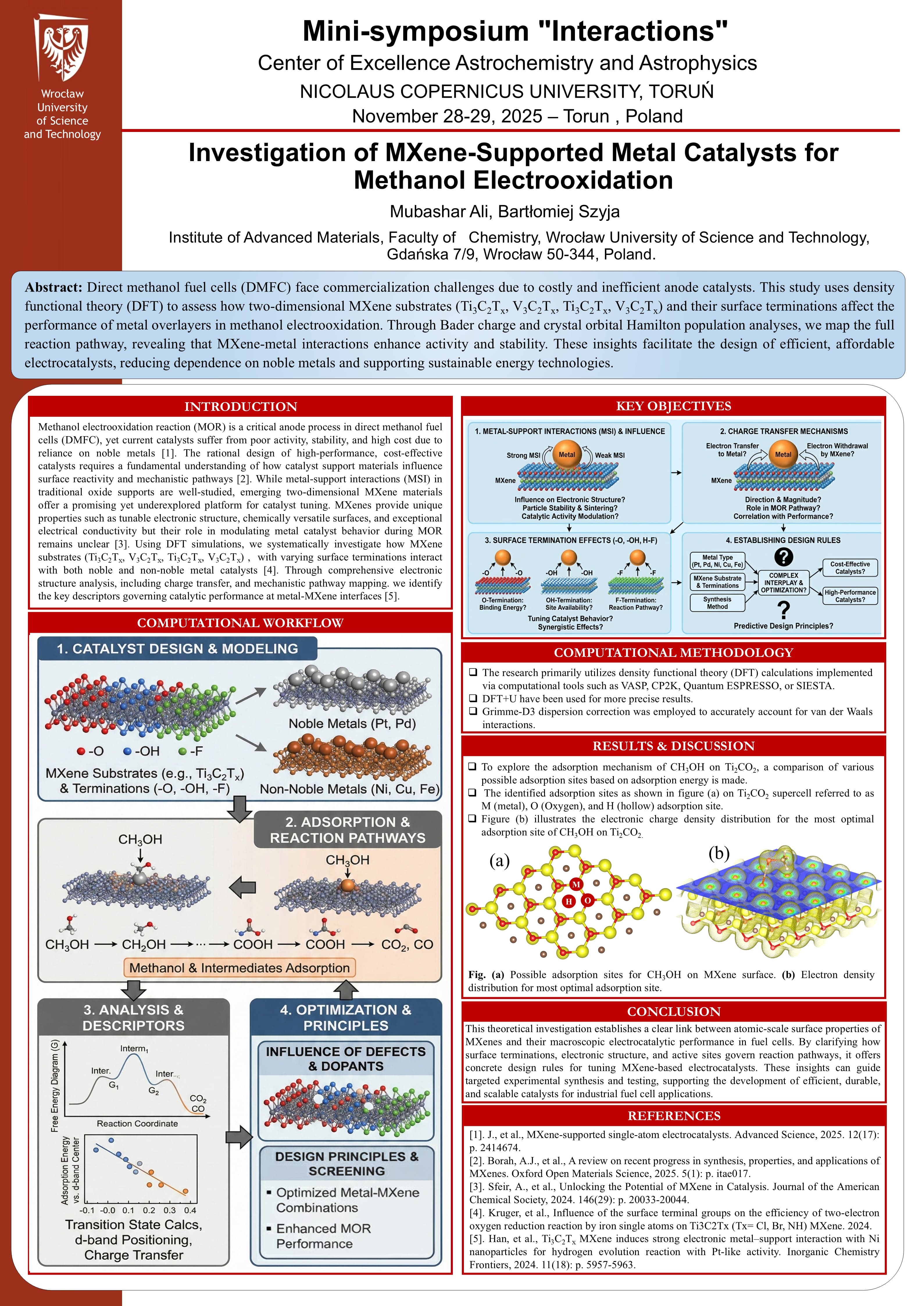
He participated in the Mini-Symposium “Interactions”, organized by the Center of Excellence in Astrochemistry and Astrophysics at Nicolaus Copernicus University, Toruń, Poland. He presented a poster entitled “Investigation of MXene-Supported Metal Catalysts for Methanol Electrooxidation,” showcasing computational insights into MXene-based electrocatalysts for energy-related applications. 🔗 Symposium website